
Every conference season, the same story plays out on the expo floor: A vendor pays tens of thousands of dollars for a premium 10x10 booth, secures a coveted breakout session speaking slot, and loads up on standard brochures. When their speaking session arrives, an executive walks on stage and reads 45 bullet-pointed slides about modern threat vectors before delivering an awkward pivot to their product suite.
The room is silent. Half the audience is checking Slack, and by the next morning, nobody remembers the session, the company, or the problem they claimed to solve. The booth ROI falls flat, leaving leadership wondering why conference sponsorships feel like pouring money into a black hole.
Meanwhile, a few rapidly growing companies dominate the hall. Their sessions are standing-room-only. Attendees aren’t enduring a sales pitch; they are laughing, taking notes, and participating in an authentic conversation. Afterward, people rush the stage to talk to the speaker, join their community, and proudly hunt down their socks, t-shirts, and laptop stickers.
The difference isn't the size of the marketing budget. The difference is having a representative who understands that security leadership at public events is not about presenting slides, it is about commanding trust through storytelling, technical credibility, and human connection.
The Modern Dilemma: The Conference ROI Downfall
Security practitioners and enterprise leaders have built an impenetrable immune system against traditional corporate marketing. They can smell a generic vendor pitch in the first two minutes of a presentation.
When a company treats a speaking slot like an extended sales deck, three things happen.
The Audience Disconnects, practitioners tune out corporate jargon and buzzwords ("single pane of glass," "paradigm shift," "AI-driven autonomous synergy").
The Brand Disappears into the Noise. When every talk sounds like an analyst report, no single vendor stands out.
The Event Investment is Squandered. A booth without brand gravity relies entirely on aggressive badge scanning. When the event ends, those leads are ice-cold because no authentic connection was ever established.
The companies breaking through this noise are ditching the script. They recognize that marketing in cybersecurity requires a rare hybrid operator: someone who possesses deep operational scars, technical fluency, the stagecraft of an educator and a pinch of a stand up comedian.
Enter the Field CISO.
Redefining the Role: What Does a Field CISO Actually Do?
A Field CISO does not manage daily SOC shifts, build firewall configurations, or approve change-management tickets. Nor are they traditional quota-carrying sales reps or corporate marketing heads.
The Field CISO operates at the exact intersection of security strategy, executive advisory, education, and brand ambassadorship.
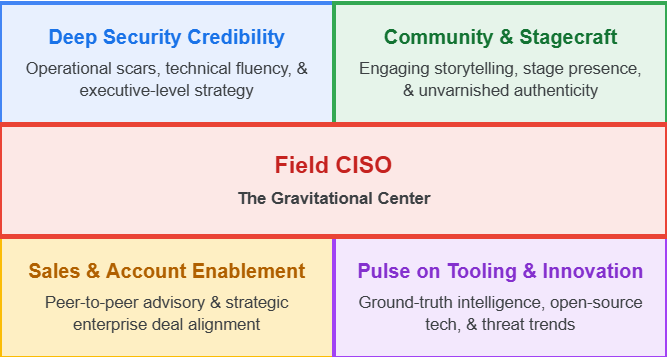
To see a Field CISO in their element, you have to watch what happens the moment they step into a crowded room.
They don’t retreat behind a podium or anchor themselves to a deck of bulleted slides. Instead, they walk to the edge of the stage, read the collective exhaustion in the room, and simply start a conversation. They understand the unspoken tension in the seats, the junior engineer overwhelmed by alert fatigue, or the director sweating next quarter’s compliance audit. Rather than reciting threat metrics, they spin complex engineering realities into human, relatable war stories. They use humor where others use corporate jargon, transforming what could have been another dry presentation into an experience where people actually look up from their phones, nod in recognition, and feel genuinely understood.
That same presence shifts seamlessly from the conference stage to the private briefing room. When sitting across the table from prospective enterprise clients, the typical vendor tension evaporates. There is no rushed quota pitch or rehearsed closing tactic. Instead, the buyer finds themselves talking to an authentic peer, someone who has lived through the misery of 2:00 AM incident response calls, navigated the politics of slashed budgets, and faced down regulatory examiners. The conversation moves from a sales transaction to strategic counsel between two professionals who share the same operational scars.
Behind that poise is someone whose finger never leaves the industry's pulse. Late at night and between sessions, they aren't scanning polished analyst reports; they are comparing notes in private back-channels with fellow practitioners, experimenting with emerging open-source tooling, and dissecting the mechanics of the newest attack vectors in real time. Because their network is built on years of shared trust, they know where the landscape is fracturing months before the rest of the market catches on. They feed that ground-truth intelligence back into their organization, giving leadership an unmistakable strategic edge.
Ultimately, they become the gravitational center of the brand. By showing up with relentless authenticity, sharp technical insight, and an educator's heart, they do something traditional marketing campaigns never achieve: they build genuine culture. Long after the lights dim on the expo floor, attendees aren’t just remembering a product logo, they are seeking out the company whose leader spoke the unvarnished truth, proudly wearing their gear, and championing the movement they represent.
Stagecraft vs. Slidecraft: Delivering Unforgettable Presentations
Anyone with an internet connection can assemble a thirty-slide deck summarizing the latest industry threat report. Very few can hold a room of cynical engineers, weary directors, and skeptical executives captivated for forty-five uninterrupted minutes.
That mastery begins with knowing precisely who is sitting in the chairs. A room filled with healthcare leaders sweating an imminent regulatory audit requires a vastly different dialogue than a crowd of cloud architects automating continuous integration pipelines. A skilled Field CISO reads the room before uttering a word, shifting cadence and terminology on the fly so the audience instantly recognizes that the person on stage hasn't just studied the theory, they have lived the exact headache being discussed.
To make that connection stick, they abandon the corporate teleprompter habit entirely. Slides cease to be walls of bulleted text or an executive crutch; instead, they serve as punchy visual anchors, crisp architectural sketches, or moments of comedic relief. When an audience is forced to read sentences off a screen, they stop listening to the human speaking. The moment a presenter steps away from the podium, looks attendees directly in the eye, and talks candidly about real-world missteps, painful breaches, and hard-earned lessons, the defensive posture in the room evaporates.
Underpinning it all is a commitment to candor and entertainment. The security industry carries enough ambient stress; presentations don't need to feel like an autopsy. By weaving in sharp humor, vivid metaphors, and gritty operational war stories, the narrative stays alive. When an audience is genuinely engaged and laughing at the absurdity of shared industry pains, they remain fully dialed in, and they instinctively link that clarity, energy, and authenticity back to your organization.
The Swag Phenomenon: When Community Becomes Advocacy
There is a direct correlation between how a company communicates on stage and how desirable their swag is on the expo floor.
Cheap, throwaway vendor swag gets tossed into hotel trash cans before attendees head to the airport. But when an organization brings compelling stage presence, community-first values, and cultural relevance to an event, their swag transforms into a badge of honor.
Attendees don't hunt down t-shirts, socks, and laptop stickers because they lack clothing or adhesives; they wear them because they want to signal alignment with a brand that "gets it." Tip of the year: Any vendor that brings light sabers to give away, will be remembered.
That level of organic advocacy cannot be bought through paid digital ads. It is earned through authentic community connection, high-value educational content, and leaders who invest in the ecosystem rather than just extracting from it.
The Competitive Edge
For organizations looking to scale, relying solely on outbound cold sequences and static conference booths is no longer sustainable. The market is saturated, attention spans are fractured, and buyers demand peer-level trust before entering any sales conversation.
Investing in a Field CISO bridges the gap between security engineering and market awareness. By putting a credible, charismatic educator in front of the community, one who understands the audience, commands the stage, and articulates an authentic vision, companies stop burning conference budgets on forgotten presentations.
Instead, they build enduring brand equity, attract lifelong customers, and turn passive audiences into passionate advocates