
Introducing the Autonomous Agent Healthcare Control Matrix
Enterprise security teams and health-tech developers are deploying fully autonomous AI agents—systems capable of calling APIs, querying databases, and executing multi-step workflows without real-time human approval. However, traditional software security policies and basic system prompts fail to ensure regulatory compliance for independent, model-driven logic loops.
To address these vulnerabilities, we are introducing the Autonomous Agent Healthcare Control Matrix (AS-IF). This framework provides a structured database of 25 precise technical controls designed to enforce runtime data boundaries on autonomous agents before they can commit unverified code or leak restricted information.
The Core Framework: Mapped Infrastructure Security
The architecture separates standard engineering security controls from specialized healthcare regulatory modules. Every control operates as an infrastructure-level proxy rather than relying on model alignment.
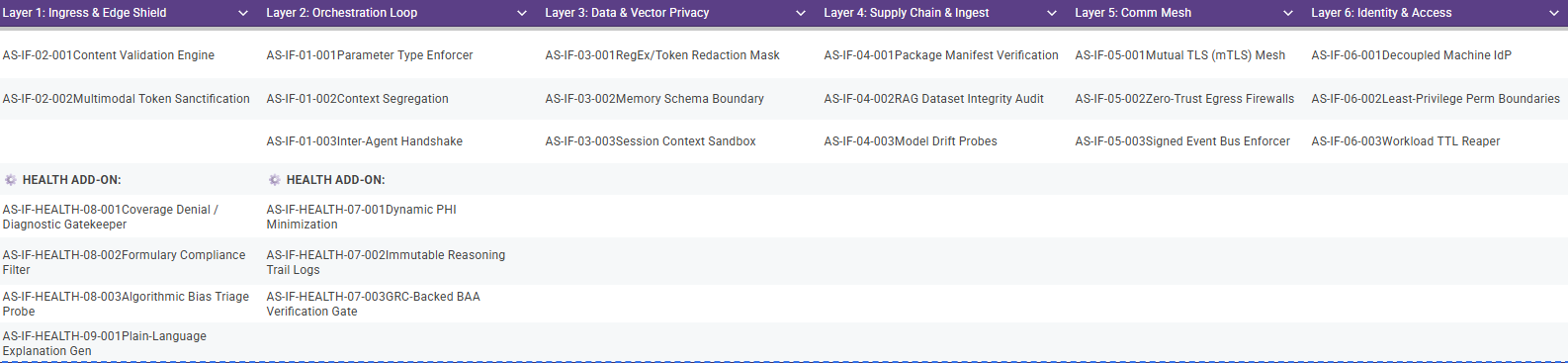
Technical Control Group Overviews
1. Ingress & Loop Integrity (Groups 1–2)
These controls operate at the input and execution level. Rather than validating text post-generation, the framework enforces strict type checking and regex constraints on arguments generated by an LLM before they are dispatched to downstream functional tools, internal APIs, or database handlers.
2. Infrastructure & Data Protection (Groups 3–6)
This layer isolates execution contexts. It enforces network constraints including Layer-7 default-deny egress policies, short-lived session token rotations, and strict container lifespans (Time-to-Live) to prevent stale, orphaned agent routines from lingering inside internal subnets.
3. The Healthcare Overlay (Groups 7–9)
The commercial extension translates HIPAA rules and CMS guidance into machine-readable parameters:
Dynamic PHI Minimization: Automates the Minimum Necessary Standard by filtering out non-whitelisted text strings via Named Entity Recognition before context chunks populate prompt strings.
GRC-Backed BAA Verification: A programmatic kill switch that intercepts outbound third-party model connections, verifies vendor compliance records via internal Governance, Risk, and Compliance (GRC) APIs, and terminates data transfer if an active Business Associate Agreement (BAA) is absent.
CMS Clinical Gatekeepers: Hardcoded validation gates that intercept agent tool actions. Any automated calculation resulting in a coverage denial, care reduction, or a medical diagnosis is blocked from writing to the Electronic Health Record (EHR) and re-routed to a Human-in-the-Loop clinical review queue.
Implementation & Distribution
The matrix is delivered as structured JSON schemas to allow programmatic ingestion straight into enterprise runtime environments, validation middleware proxies, and SOC SIEM audit logging pipelines.
AS-IF Core (Groups 1–6): Open-source and available via our public GitHub repository under the Apache-2.0 license for standard infrastructure protection.
AS-IF Healthcare Overlay (Groups 7–9): Available under a commercial enterprise license via our token-gated private repository for platforms processing regulated patient data.
For licensing documentation, integration blueprints, or enterprise support, contact us